
What is meningitis?
Meningitis is inflammation of the lining around the brain and spinal cord – the meninges.
What is sepsis?
Septicaemia is blood poisoning caused by the same germs as meningitis and is life-threatening. It can occur with or without meningitis and is sometimes referred to as sepsis. Medically, septicaemia is when bacteria enters the bloodstream, causing blood poisoning which triggers sepsis. Sepsis is an overwhelming and life-threatening response to infection that can lead to tissue damage, organ failure and death.
Both meningitis and sepsis can kill in hours. It’s critical to know the symptoms so you can act fast.
Know the symptoms
-
Fever and/or vomiting
Meningitis ✓ Sepsis ✓
-

Severe headache
Meningitis ✓
-

Limb / joint / muscle pain (sometimes with stomach pain / diarrhoea)
Sepsis* ✓
-

Cold hands and feet / shivering
Sepsis* ✓
-

Pale or mottled skin
Sepsis ✓
-

Breathing fast / breathless
Sepsis ✓
-

Rash (anywhere on the body)
Meningitis* ✓ Sepsis* ✓
-

Stiff neck (less common in young children)
Meningitis* ✓
-

Dislike of bright lights (less common in young children)
Meningitis* ✓
-

Very sleepy / vacant / difficult to wake
Meningitis ✓ Sepsis ✓
-

Confused / delirious
Meningitis* ✓ Sepsis* ✓
-

Seizures (fits)
Meningitis* ✓
If I think someone has meningitis symptoms, when do I go to hospital?
Someone who has meningitis or sepsis can become seriously ill very quickly, so always trust your instincts and get medical help fast by speaking to a health professional.
The first symptoms are usually fever, vomiting, headache and feeling unwell. Limb pain, pale skin, and cold hands and feet often appear earlier than the rash, neck stiffness, dislike of bright lights and confusion.
It is important to understand that not everyone gets all the meningitis and sepsis symptoms: they can appear in any order.
What to do if you think your baby or child is unwell with meningitis or septicaemia
Parents or carers are often unsure when to call for medical help when they suspect meningitis or septicaemia (the blood poisoning form of meningitis, often called sepsis).
That is why we have worked with health professionals to create this red and amber symptoms checker, to tell you what actions to take. Often called our safety-netting resources, these will guide you on what are high or medium risk symptoms, and what to do.
Red symptoms: high risk | take immediate action
- Over 38°C in babies under three months.
- Has a temperature and feels abnormally cold to touch / very cold hands and feet.
- Very fast breathing, finding it much harder to breathe than normal, or noticeable pauses in breathing.
- Grunting and / or noises with every breath.
- Very lethargic / difficult to wake / not responding.
- Fitting / convulsion / seizures.
- Weak, high pitched or continuous crying in a younger child.
- Confusion or unusually irritable.
- Soft spot on a baby’s head is bulging.
- Stiff neck, especially when trying to look up and down.
- Unusually sleepy, stiff or floppy baby.
- Blue skin, lips or tongue.
- Very pale or mottled skin.
- A rash that does not fade when pressed with a glass.
- Not had a wee or wet nappy for 12 hours or more.
- Very thirsty and not able to keep fluids down.
- Bloody or black ‘coffee ground’ sick.
Young infants are particularly vulnerable to serious infection. Seek urgent medical help if your baby has a combination of any of the following symptoms, with or without a fever:
- Persistent refusal to feed.
- Lethargic / excessively sleepy.
- Irritable.
- Stiff or floppy body.
- Weak / high pitched or continuous cry.
- Grunting.
- Soft spot on the baby’s head is bulging.
Some of these red, high-risk symptoms are not typical signs of meningitis or septicaemia (sepsis) but are still signs of severe illness, so, if your child is unwell and has any of the red symptoms, get urgent medical help.
Remember, always trust your instincts: parents, guardians or carers often know when their child is seriously ill. If your child is ill and getting worse, don’t be afraid to seek medical help immediately, even if you have already seen a doctor.
Amber symptoms: medium risk | get professional medical advice
- Over 39°C in babies aged three to six months.
- High temperature in a child who shows no interest in anything, or high temperature for more than five days.
- Low temperature (below 36°C, checking three times in a ten minute period).
- Fast breathing.
- Cough that sounds like a seal barking.
- Noisy or crackly breathing.
- Nostrils are flaring.
- In an older child, they can’t say more than a few words.
- Unusually sleepy.
- Child can’t be encouraged to show interest in anything / not wanting to do very much.
- Not responding normally to family or carers.
- Child under five not smiling.
- Shivering or shaking.
- Severe headache.
- Dislike of bright lights.
- Limb / joint / muscle pain.
- Not using / putting weight on an arm, leg, hand or foot.
- Swelling of a limb or joint.
- Pale skin, lips or tongue in a child under five.
- Sunken eyes.
- Rash that does fade when pressed with a clear glass.
- Not feeding or eating much.
- Not drinking for more than eight hours (when awake).
- Dry mouth.
- Under one year old with vomiting and / or diarrhoea.
- Vomiting more than twice in the last 24 hours or has bile-stained vomit.
- More than five watery poos in a 24 hour period.
- Only one wet nappy or wee in the last 12 hours.
You may have already seen a health professional about your child, but it is important to get more medical advice if:
- You feel that your child is worse than when you previously spoke to a health professional.
- You are more worried about your child than when you previously spoke to a health professional.
- You are concerned that you are unable to look after your child.
What is the meningitis rash?
If you are seriously worried about someone who is ill, don’t wait for a rash to appear – get medical help. But if they are already ill and have a rash, or one appears, use the tumbler test.
The tumbler test
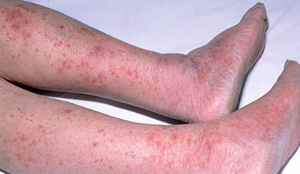
Press a clear glass tumbler firmly against the rash. If you can see the marks clearly through the glass get urgent medical help immediately.
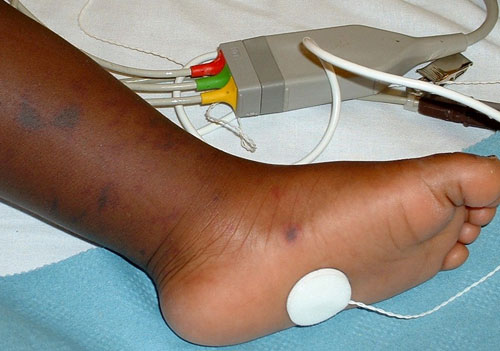
Check the entire body. Look out for tiny red or brown pin-prick marks which can change into larger red or purple blotches and blood blisters.
The darker the skin the harder it is to see a septicaemic rash, so check lighter areas like the palms of hands and soles of feet or look inside the eyelids and the roof of the mouth.
Remember, a very ill person needs medical help even if there are only a few spots, a rash or no rash at all. More on what is the meningitis rash.

Other symptoms
When deciding whether a child is well enough to go home or needs to be in hospital, a health professional needs to take measurements such as heart rate, breathing rate, oxygen level and alertness.
National UK guidelines outline what doctors should measure in children with fever or suspected infection and when they should refer children to hospital. You can read these guidelines here:
- Fever in under fives: assessment and initial management
- Meningitis (bacterial) and meningococcal septicaemia in under 16s: recognition, diagnosis and management
- Sepsis: recognition, diagnosis and early management
More support
If you have questions or concerns about meningitis or sepsis you can ring our Support Services on 080 8800 3344 in the UK or 1800 41 33 44 in the Republic of Ireland. But don’t wait to speak to us if you think you or someone you care about is seriously ill – always get professional medical support.