
What is meningitis?
- Meningitis is the swelling of the lining of the brain and spinal cord. It is usually caused by a bacterial, viral or fungal infection.
What is meningococcal meningitis?
- Meningococcal meningitis is meningitis caused by meningococcal bacteria. The same bacteria can also cause sepsis.
- Different bacteria can cause meningitis. Meningococcal bacteria is one of the common causes.
- There are different groups that can cause meningococcal meningitis: A, B, C, W and Y.
- Meningococcal B is often referred to as ‘MenB’.
- Symptoms can come on quickly and meningitis can become life-threatening within hours.
- It’s very important you know the symptoms of meningitis and can spot them early. Not everyone gets all the symptoms: they can appear in any order.
How common is MenB?
- Bacterial meningitis is a severe disease, but it’s relatively uncommon. MenB is the most common cause of bacterial meningitis in the UK.
How does MenB spread?
- MenB spreads through very close or long-lasting contact. For example, living in the same household or intimate kissing. Sharing drinks, cigarettes or vapes can increase the chance of passing on germs that can cause MenB. This is because they can carry saliva.
Am I at risk from MenB?
MenB can affect anyone, but children under the age of five and teenagers are high-risk groups.
Other risk factors include:
- Exposure to environmental factors.
- Whether you have certain pre-existing medical conditions.
- Whether you’ve been in close contact with someone who has MenB.
- If you live in the same household as someone with MenB or are a very close contact (spouse or partner), you’re generally considered to be more at risk than other contacts.
Are there vaccines that protect against MenB?
- Yes, there are currently two vaccines available in the UK that protect against MenB.
- Bexsero® is included in the NHS vaccine schedule for infants and for individuals in high-risk groups.
- Trumenba®, another MenB vaccine,is also available privately for adults and children aged 10 and above. It is not currently available on the NHS.
When is the MenB vaccine given?
- In the UK, the MenB vaccine is offered to babies at 8 and 12 weeks old, with a booster aged one.
- In Ireland, the vaccine is offered at 8 and 16 weeks old, with a booster aged one.
How do I find out if I’ve had the MenB vaccine?
There are a few ways to find out if you or your child has had the MenB vaccine:
- Check the NHS app (if you’re registered) – this should show you your vaccine history and can be set up to show you this information for your child.
- Check your child’s red book – this should show all vaccines your child has had from birth to four years.
- Ask your GP – they should have a record of any vaccines you or your child have had.
- Ask a parent/carer – they may remember if you’ve had the vaccine.
What do I do if I haven’t had the MenB vaccine?
- If your child has missed any doses of their MenB vaccine, they are still eligible to receive them free of charge up to the age of two.
- MenB vaccination is available free of charge to people with medical conditions that increase the risk of contracting MenB disease, in some circumstances when people have been in close contact with someone who was ill with MenB meningitis and/or sepsis, and in occupations which put people at increased risk of disease.
- We have been campaigning for better protection for teenagers and young adults since 2015, as they are a high-risk group in the UK. In the UK today, people can opt to purchase MenB vaccination privately if they have not received it on the NHS. This can be accessed through local pharmacies, travel clinics and some private GP practices.
How long does protection from the MenB vaccine last?
- Research shows the MenB vaccine provides protection for around five years, although this varies between individuals.1 The timing of the doses given to babies on the NHS schedule protects them when they are most at risk of infection.
- This means that the MenB vaccine given in infancy does not protect teenagers from infection. Any further vaccination would need to be purchased privately.
- You may be considering further vaccination during the teenage years, which is when the risk of meningitis increases again. Anyone choosing to have the vaccine would need a full course, which consists of two doses given at least one month apart.
Do I need a MenB vaccine myself?
- It’s a personal choice whether to have the MenB vaccine outside of the routine NHS schedule.
- Groups who are at higher risk due to proximity to an outbreak of MenB may be eligible for a free vaccine via the NHS. The UKHSA website has information on who is currently eligible.
How do I get the MenB vaccine?
- For routine vaccinations, your GP surgery should contact you to offer the vaccine for your baby. If they don’t, contact them directly.
- If you think you may be at higher risk of MenB for , contact your GP surgery to check your eligibility for the vaccine. If you are not entitled to the vaccine and would like to purchase it, it is available from many travel clinics and pharmacies, and some private GP practices.
Does the MenB vaccine provide herd protection?
- No, the MenB vaccine doesn’t reduce the spread of this bacteria among the population. It protects individuals from the disease, but it doesn’t prevent them from carrying the bacteria that cause it.
Is the MenB vaccine safe?
- The MenB vaccine is a safe and very effective vaccine.
- As with all drugs, vaccines can cause side effects. Side effects of MenB vaccines are similar to other routine vaccines and may include: irritability/crying/restlessness; loss of appetite, fever and feeling tired in infants. Headache and pain, redness and swelling at the injection site can also sometimes occur in all age groups receiving the vaccine.
Do I need antibiotics if I’ve been near someone with MenB?
- Preventative antibiotics are normally offered to anyone in close, long-lasting contact with a confirmed or suspected case of MenB. This is to clear any meningococcal bacteria they may be carrying and reduce the risk of them becoming ill or passing the bacteria on to others.
- If there has been an outbreak, these antibiotics are sometimes offered to people in a slightly wider network after contact tracing.
- For more information, including where to collect these antibiotics, see the UKHSA website.
If I’ve been given preventative antibiotics for MenB, would I still need a vaccine?
- For single cases of MenB, close contacts are not normally vaccinated.
- If there has been an outbreak, a vaccine can also be offered. The antibiotics provide very quick protection and the vaccine provides longer-term protection.
- Not everyone who receives antibiotics in an outbreak will necessarily be offered a vaccination. The need for this varies between outbreaks.
References
- Wang, B., Giles, L., Andraweera, P., McMillan, M., Beazley, R., Almond, S., Lally, N., Bell, C., Flood, L., Ward, J., Marshall, H. (2025). Long-Term Protection Against Invasive Meningococcal B Disease and Gonococcal Infection 5 Years After Implementation of Funded Childhood and Adolescent 4CMenB Vaccination Program in South Australia: An Observational Cohort and Case-Control Study. Clinical Infectious Diseases, 81(4), e202–e210. https://doi.org/10.1093/cid/ciaf372
Author: Meningitis Research Foundation
Published: 24 March 2026.
Get support
Physical and emotional recovery from meningitis and its impact can be different for everyone. Support is available if meningitis has affected you or someone you know.
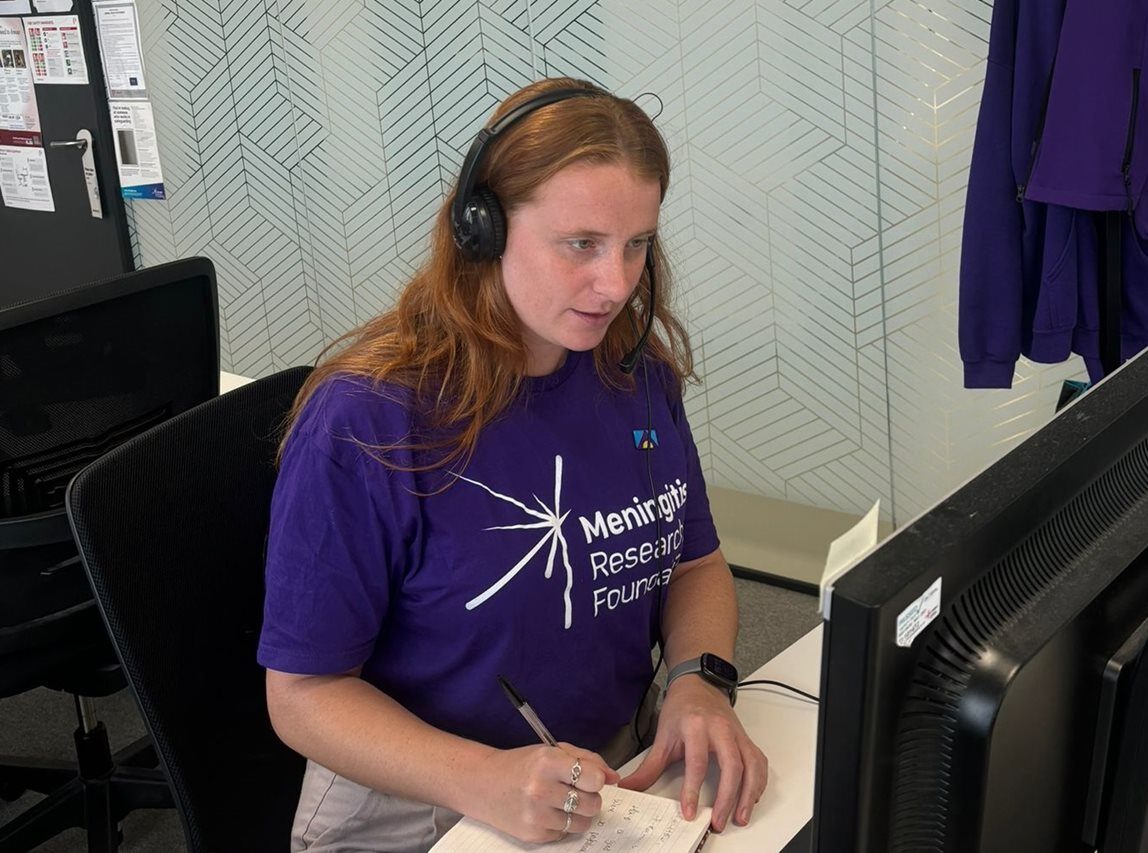
If you're in the UK or Ireland, the Meningitis Research Foundation Support Services team are ready to answer your questions.
If you're outside the UK and Ireland, our member network is the Confederation of Meningitis Organisations (CoMO). CoMO is dedicated to reducing the impact of meningitis globally, with members across the world. It's a great resource for finding support where you live.